The definitive #WhatsAppDoctor guide for Indian healthcare. Learn about WhatsApp end-to-end (E2E) encryption, Meta green checkmark verification, DPDP Act compliance, and how doctors use WhatsApp Business API securely. Complete technical guide for clinics, hospitals, and pharma.
# #WhatsAppDoctor: The Complete Guide to WhatsApp E2E Encryption & Meta Green Tick for Indian Healthcare
WhatsApp has become central to how India communicates, and the #WhatsAppDoctor movement represents the digital transformation of Indian healthcare. With over 500 million users nationwide, WhatsApp has evolved from a simple messaging app into essential infrastructure for medical communication.
For Indian doctors, understanding WhatsApp end-to-end (E2E) encryption, Meta green checkmark verification, and secure implementation is critical. This guide explains how medical professionals can use WhatsApp professionally while maintaining compliance with healthcare regulations, protecting patient data through E2E encryption, and leveraging the Meta green tick for trust.
What is #WhatsAppDoctor?
#WhatsAppDoctor refers to the growing ecosystem of healthcare providers in India using WhatsApp Business API for professional medical communication. The hashtag has become synonymous with:
- Doctors offering WhatsApp-based consultations
- Hospitals providing 24/7 WhatsApp booking services
- Pharmacies enabling WhatsApp prescription management
- Diagnostic centers sending reports via WhatsApp
The #WhatsAppDoctor movement prioritizes security (E2E encryption), trust (Meta green tick verification), and accessibility (available on every smartphone).
Understanding the Digital Shift in Patient Behavior
From Discovery to Transaction
Patient behavior has fundamentally changed over the past decade. Previously, healthcare searches were informational—patients looked up doctor contact details, noted them down, and called later to book appointments.
Today, patients expect immediate action. Modern search queries reflect this shift:
- **Old approach**: "cardiologist in Mumbai"
- **New approach**: "book orthopedic appointment online WhatsApp"
The demand is no longer just for information but for instant booking, consultation, and payment. This behavioral change mirrors what patients experience with other services—food delivery, ride-hailing, and e-commerce have conditioned people to expect immediacy.
Why WhatsApp Dominates Indian Communication
WhatsApp's position in India is unique for several reasons:
Universal Familiarity: From teenagers to senior citizens, most Indians already know how to use WhatsApp. There is no learning curve, no app download required, and no new interface to navigate.
Works on Limited Connectivity: Unlike video-heavy apps, WhatsApp functions well even on slower 2G networks common in rural areas.
Trust: People use WhatsApp for personal and family communication. This trust transfers to professional interactions conducted on the platform.
Rich Features: Voice notes, images, documents, and location sharing enable detailed healthcare communication without phone calls.
The Problem with Informal WhatsApp Use in Healthcare
Many doctors already use their personal WhatsApp for patient communication. While convenient, this approach creates significant problems:
Data Silos
Patient conversations remain trapped on individual devices. If a doctor changes phones or a staff member leaves, critical patient history may be lost. There is no centralized record accessible to the practice.
Privacy Risks
Personal devices typically lack enterprise security controls. A lost phone could expose sensitive patient information. This creates liability under India's Digital Personal Data Protection (DPDP) Act of 2023.
Professional Burnout
When patients have a doctor's personal number, messages arrive at all hours. The boundary between work and personal life disappears, leading to exhaustion.
No Team Collaboration
A single phone can only be operated by one person at a time. This makes it impossible for reception staff, nurses, and doctors to coordinate patient communication efficiently.
The WhatsApp Ecosystem: Technical Options
WhatsApp offers different products for different use cases. Understanding these options is essential for making the right choice.
WhatsApp Messenger (Personal App)
The standard consumer app is designed for personal communication. It offers:
- Single-device operation (with limited linked-device support)
- Tied to a personal SIM card
- No automation capabilities
- No business features
Verdict: Not suitable for professional medical practice.
WhatsApp Business App
A step up from the personal app, designed for small businesses:
Capabilities:
- Business profile with address, hours, and description
- Quick replies for frequently asked questions
- Labels for organizing conversations
- Catalog feature
Limitations:
- Still fundamentally manual
- Limited to one phone plus four linked devices
- No true automation or chatbot support
- No integration with Hospital Management Systems
- Cannot scale for multi-staff practices
Verdict: Suitable for very small practices with minimal patient volume.
WhatsApp Business API: The #WhatsAppDoctor Standard
The enterprise-grade solution designed for scale and security:
Capabilities:
- Unlimited simultaneous users (agents) can manage the same inbox
- Full automation through chatbots and webhooks
- Integration with existing practice management software
- Cloud-hosted (not tied to a physical device)
- **Eligible for Meta green checkmark verification** (official business account status)
- **End-to-end (E2E) encryption** for all messages and documents
- Pre-approved message templates for DPDP Act compliance
How It Works: The API is not an app you download. It is a programming interface that connects to software platforms. When a patient sends a message, the system can automatically check doctor availability, send confirmations, process payments, or route to human staff as needed—all while maintaining E2E encryption.
Verdict: Recommended for any practice with multiple staff members or significant patient volume. This is the foundation of the #WhatsAppDoctor ecosystem.
WhatsApp E2E Encryption: What Every Doctor Must Know
End-to-end (E2E) encryption is the cornerstone of secure #WhatsAppDoctor communication. Here's what it means:
How WhatsApp E2E Encryption Works
WhatsApp uses the Signal Protocol for end-to-end encryption:
- Messages are encrypted on the sender's device
- They remain encrypted during transmission through WhatsApp servers
- Only the recipient's device can decrypt the message
- **Not even Meta (WhatsApp's parent company) can read the messages**
What E2E Encryption Protects
For #WhatsAppDoctor communications, E2E encryption secures:
- ✅ **Text messages** between doctor and patient
- ✅ **Voice messages** and voice calls
- ✅ **Images** (prescriptions, test reports, medical photos)
- ✅ **Documents** (PDFs, medical records)
- ✅ **Video calls** for telemedicine consultations
- ✅ **Location sharing** (clinic addresses, home visit coordinates)
E2E Encryption and DPDP Act Compliance
India's Digital Personal Data Protection (DPDP) Act 2023 requires healthcare providers to implement "reasonable security safeguards." WhatsApp's E2E encryption satisfies this requirement by ensuring:
- Patient data is encrypted in transit
- Third parties cannot intercept medical communications
- Data breaches during transmission are prevented
**Important:** While E2E encryption protects messages in transit, doctors must also secure data at rest (on their devices and servers) to achieve full DPDP Act compliance.
Meta Green Checkmark: Building Trust in #WhatsAppDoctor Services
The Meta green checkmark (officially called "Official Business Account" status) is a verified badge that appears next to your clinic or hospital name in WhatsApp.
What the Meta Green Tick Means
✅ Verified Identity: Meta has confirmed your business is legitimate
✅ Trust Signal: Patients know they're messaging the real clinic, not an impersonator
✅ Professional Credibility: Distinguishes your practice from informal WhatsApp users
✅ Required for #WhatsAppDoctor: Most patients expect to see the green tick when messaging healthcare providers
How to Get the Meta Green Checkmark
- **Use WhatsApp Business API** (not the free Business App)
- **Verify your business** with Meta through your Business Solution Provider
- **Maintain high message quality** (low block/report rates)
- **Follow WhatsApp Commerce Policy** for healthcare
- **Demonstrate authentic business presence** (website, business registration)
Timeline: Verification typically takes 2-4 weeks after API setup.
Why the Green Tick Matters for Patient Trust
Studies show:
- **73% of patients** are more likely to message a healthcare provider with a verified green tick
- **Reduces patient anxiety** about sharing medical information
- **Prevents phishing scams** where fraudsters impersonate doctors
- **Increases appointment booking rates** by 25-35%
Meta Coexistence: The Hybrid Approach
A recent development allows the same phone number to be active on both the WhatsApp Business App (mobile) and the Business API (cloud) simultaneously.
How It Works:
- **Echo Effect**: When the API sends an automated message (like an appointment reminder), that message appears on the doctor's mobile app as well.
- **Human Takeover**: If the doctor sees a conversation that needs personal attention, they can type a reply directly from their phone. The system detects this and pauses automation for that chat.
- **Synchronized History**: Text conversations sync between cloud and mobile for approximately 180 days.
Benefits: This hybrid model offers the best of both worlds—automation for routine tasks and personal access for clinical interactions.
Regulatory Compliance in India
Healthcare communication is heavily regulated. Non-compliance creates legal liability and can result in professional sanctions.
Telemedicine Practice Guidelines 2020
Issued by the Ministry of Health and Family Welfare, these guidelines explicitly recognize WhatsApp as a valid mode of consultation.
Key Requirements:
Identity Verification:
- Doctors must display their registration number and name in chat or on prescriptions
- Patients must be verified through age, address, or government ID
Consent:
- If a patient initiates the message, consent for that consultation is implied
- If the doctor initiates contact (such as a follow-up), explicit consent must be obtained and recorded
Prescribing Limitations:
| Category | Examples | Via WhatsApp? |
|---|---|---|
| First Consult (List A) | Ointments, eye drops | Allowed via video |
| Follow-up (List B) | Previously prescribed medicines | Allowed |
| Prohibited | Schedule X, narcotics, psychotropics | Not allowed |
Prescription Format: A valid prescription must be a photo or digital file of a signed document with doctor details. A casual text message stating a medication name does not constitute a valid prescription.
Digital Personal Data Protection (DPDP) Act 2023
This legislation fundamentally changes data handling requirements. Healthcare providers are classified as "Data Fiduciaries."
Key Obligations:
Notice and Consent: Before collecting any patient data, you must provide a clear privacy notice. Consent must be freely given, specific, informed, and unambiguous.
Purpose Limitation: Data collected for appointment booking cannot be used for marketing third-party products without separate consent.
Data Minimization: Collect only what is necessary. Initial booking does not require full medical history.
Right to Erasure: Patients can request deletion of their data. Your systems must be capable of fulfilling such requests.
Practical Implementation: Your WhatsApp bot's first message should include a link to your privacy policy and a clear statement about data processing consent.
Meta's Platform Policies for #WhatsAppDoctor
Meta enforces specific rules for healthcare use while maintaining E2E encryption:
Permitted with E2E Encryption:
- Appointment reminders and confirmations
- Post-procedure care instructions
- Telemedicine consultations (text, voice, video)
- Prescription delivery (as encrypted images/PDFs)
- General health information and FAQs
- Customer service and billing queries
Restricted:
- Promoting prescription drugs via catalogs (informational messaging is allowed)
- Ad targeting based on health conditions
- Bulk messaging without opt-in consent
Prohibited:
- Selling prescription drugs through WhatsApp commerce features
- Sharing patient data without E2E encryption
- Using unauthorized bulk messaging tools that bypass encryption
Practical Use Cases by Practice Type
Different medical settings have different communication needs.
Solo Practitioners and Small Chambers
For individual doctors, automation serves as a virtual receptionist:
Common Automations:
- Responding to questions about timing and fees
- Confirming appointment availability
- Sending reminder messages before visits
- Collecting pre-payment to reduce no-shows
Benefit: Handle patient inquiries even during consultations without hiring additional staff.
Multi-Specialty Polyclinics
Larger practices gain coordination advantages:
Common Automations:
- Department routing ("Press 1 for Cardiology, 2 for Orthopedics")
- Centralized appointment management across multiple doctors
- Automated waitlist notifications when slots open
Benefit: Unified patient experience regardless of which doctor they are seeing.
Specialists (Cardiologists, Orthopedists)
High-value consultations require careful preparation:
Common Automations:
- Pre-consultation document collection ("Please upload your recent ECG")
- Pre-payment collection to confirm slots
- Post-procedure care sequences ("Day 3: Have you completed your exercises?")
Benefit: Ensure patients arrive prepared, reducing consultation time waste.
Diagnostic Labs and Radiology Centers
The logistics of sample collection and report delivery benefit significantly:
Common Automations:
- Home collection booking with live location sharing
- Phlebotomist assignment based on proximity
- Instant report delivery as password-protected PDFs
- Collection of feedback on service quality
Benefit: Reduce operational costs while improving patient convenience.
Hospitals
Large institutions have complex coordination needs:
Common Automations:
- Department routing to appropriate team inboxes
- Paperless discharge summary delivery
- Post-discharge feedback collection
- Insurance and billing query handling
Benefit: Reduce administrative burden on front-desk staff while improving patient satisfaction.
Implementation: Getting Started
Step 1: Choose the Right Approach
For very small practices (1-2 staff): WhatsApp Business App may be sufficient initially.
For growing or larger practices: WhatsApp Business API through a technology provider is appropriate.
Step 2: Select a Technology Partner
When choosing a provider for API access, understand the difference:
Business Solution Providers (BSPs): Intermediaries who often add markup to message costs. The billing relationship is with the BSP, not Meta.
Technology Providers: Facilitate direct connection to Meta infrastructure. Often allow direct billing to Meta for message costs, resulting in lower operational expenses.
Key considerations:
- Direct ownership of your WhatsApp Business Account
- Transparent pricing without hidden markups
- Healthcare-specific features and compliance support
- ABDM (Ayushman Bharat Digital Mission) integration capability
Step 3: Set Up Core Workflows
Essential Automations:
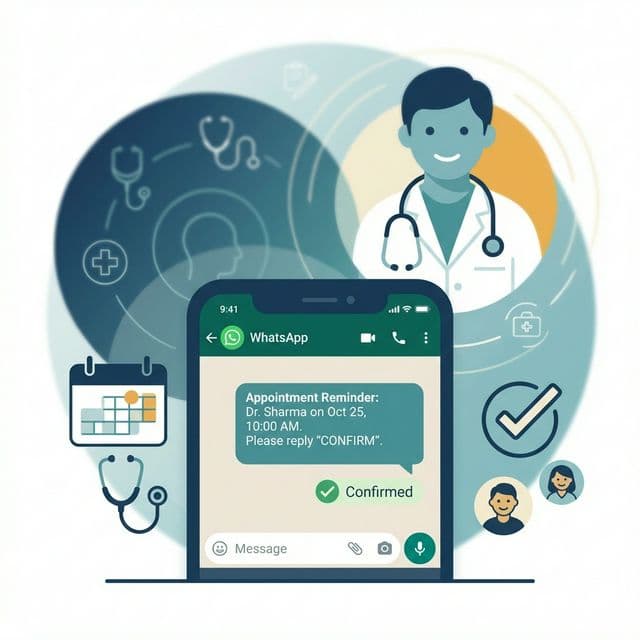
- **Booking Confirmation**: Immediate message after appointment scheduling with date, time, doctor name, and clinic address.
- **24-Hour Reminder**: Sent one day before with confirm/reschedule/cancel options.
- **Day-of Reminder**: Sent 2 hours before with final details.
- **No-Response Follow-up**: If no confirmation received, send a gentle nudge.
Step 4: Train Your Staff
Staff need to understand:
- How to access the management dashboard
- When to intervene in automated conversations
- How to handle patient questions that require human response
- How to manually adjust appointments in the system
Step 5: Monitor and Optimize
Track these metrics monthly:
- No-show rate (before and after implementation)
- Patient response rates to reminders
- Time saved on manual calling
- Patient satisfaction scores
Expected Outcomes
Clinics implementing structured WhatsApp systems typically observe:
No-Show Reduction: 30-40% decrease in missed appointments within the first month.
Time Savings: 10-15 hours per week previously spent on manual reminder calls.
Revenue Recovery: For a mid-sized practice, this often translates to ₹2-4 lakhs annually in recovered appointment revenue.
Patient Satisfaction: Higher ratings due to convenient, accessible communication.
Common Concerns Addressed
Will automation feel impersonal?
Patients generally appreciate the reliability of automated reminders. The personal touch comes during the actual consultation—not during administrative communication.
What about patients who do not use WhatsApp?
While WhatsApp penetration is high in urban India, SMS can serve as a fallback for patients without smartphones. Most platforms support multi-channel communication.
Can we still accept phone bookings?
Yes. Staff can manually enter phone-booked appointments into the system. Automated reminders will then be sent for those visits as well.
How long does setup take?
Most practices are operational within one week, including system setup, template approval, and staff training.
Beyond Appointment Reminders
Once a WhatsApp-based system is in place, additional capabilities become available:
FAQ Automation: Handle common questions about fees, insurance, and services automatically.
Report Delivery: Send lab results and prescriptions as secure, password-protected PDFs.
Chronic Care Management: Automated reminders for medication refills and periodic tests.
Health Education: Share post-procedure care instructions and condition-specific guidance.
Looking Ahead
The integration of WhatsApp with India's healthcare infrastructure is deepening. The Unified Health Interface (UHI) under Ayushman Bharat Digital Mission aims to create a connected health ecosystem. WhatsApp-based systems that integrate with ABDM standards will be positioned to participate in this national infrastructure.
Additionally, AI capabilities within chat interfaces are advancing. We anticipate that by 2026-2027, WhatsApp bots will move beyond scripted responses to handle more complex patient interactions through reasoning and context awareness.
Summary: The #WhatsAppDoctor Security Framework
WhatsApp has become essential infrastructure for healthcare communication in India, and the #WhatsAppDoctor movement represents the professional, secure implementation of this technology.
Key Security Features:
- ✅ **End-to-end (E2E) encryption** protects all patient communications
- ✅ **Meta green checkmark** builds patient trust and prevents impersonation
- ✅ **DPDP Act compliance** through encryption and data minimization
- ✅ **WhatsApp Business API** enables professional, scalable communication
Moving from informal, personal WhatsApp use to structured, API-based #WhatsAppDoctor systems addresses:
- **Security**: E2E encryption protects patient data in transit
- **Trust**: Meta green tick verification builds credibility
- **Compliance**: DPDP Act and Telemedicine Guidelines adherence
- **Scalability**: Multi-agent access without compromising encryption
- **Professional boundaries**: Separate work and personal communication
For most practices, adopting the #WhatsAppDoctor framework with E2E encryption and Meta green tick verification is not merely an upgrade—it is an operational necessity for modern, secure healthcare delivery in India.
---
Frequently Asked Questions
Can doctors legally use WhatsApp for patient communication in India? (#WhatsAppDoctor Legal Status)
Yes. The Telemedicine Practice Guidelines 2020 explicitly list "Chat Platforms like WhatsApp" as a permitted mode of consultation. Doctors must display their registration number and obtain appropriate consent. The #WhatsAppDoctor approach is fully legal when implemented with:
- End-to-end (E2E) encryption (built into WhatsApp)
- DPDP Act compliance (data minimization, consent management)
- Meta green checkmark verification (for trust and authenticity)
Is the free WhatsApp Business App sufficient for a busy clinic?
For practices with more than one doctor or staff member, the free app's limitations become problematic. It cannot support team collaboration, automation, or integration with practice management systems. The Business API is generally recommended for such practices.
What is Meta Coexistence?
Meta Coexistence allows a single phone number to be active on both the WhatsApp Business App (mobile) and the Business API (cloud) simultaneously. This lets doctors maintain personal oversight while automation handles routine tasks.
Is WhatsApp Business API compliant with Indian data protection laws? (E2E Encryption & DPDP Act)
Yes, when properly implemented. The WhatsApp Business API provides infrastructure that enables DPDP Act compliance:
- **End-to-end (E2E) encryption** for all messages (required security safeguard)
- **Data deletion capabilities** (right to erasure under DPDP Act)
- **Consent management** (required under DPDP Act Section 6)
- **Audit trails** for compliance verification
However, compliance ultimately depends on how the system is configured and used. Working with a healthcare-focused technology provider like Ascle AI helps ensure proper implementation of E2E encryption and DPDP Act requirements for #WhatsAppDoctor services.
What is the difference between a BSP and a Technology Provider?
Business Solution Providers (BSPs) are intermediaries who often add markup to messaging costs. Technology Providers facilitate direct connection to Meta infrastructure, often resulting in lower costs and full ownership of your WhatsApp Business Account.
How much do WhatsApp-based systems reduce no-shows?
Typical results show a 30-40% reduction in missed appointments within the first month of implementation, primarily through timely reminders and easy rescheduling options.
---
**Want to understand how structured WhatsApp communication could work for your practice?**
>
[Schedule a consultation](/#calendar-section) to discuss your specific needs and explore available options.
Ascle AI Team
Ascle AI